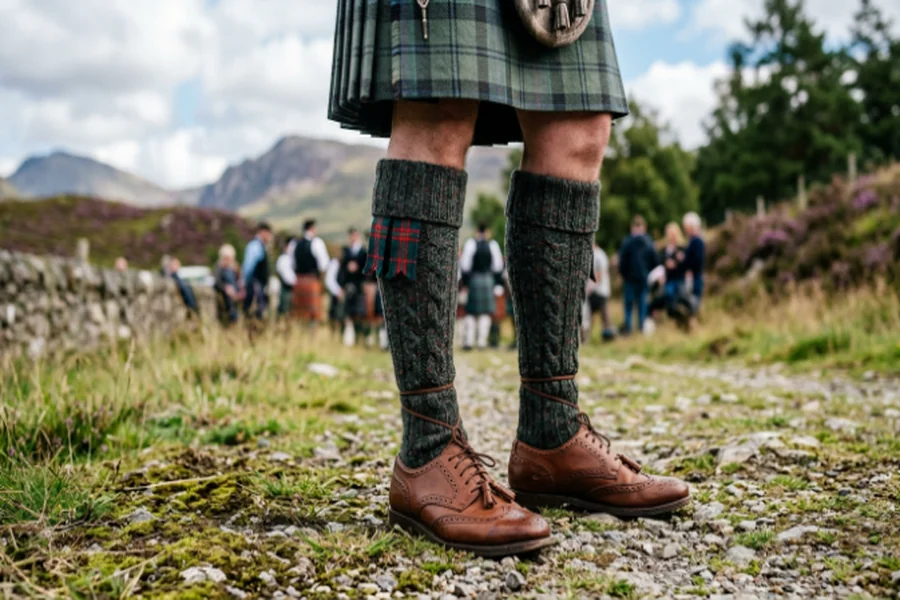
There’s a specific moment when men shopping for their first kilt realize they’ve been thinking about the wrong things. They’ve spent weeks comparing tartans, debating 5-yard versus 8-yard construction, and reading reviews of jacket styles. Then someone asks them what kilt socks they’re planning to wear — and they realize they hadn’t given the socks a second thought.
This is the most common rookie mistake in kilt shopping, and it’s the one that quietly ruins more first kilt outfits than any other single decision. The kilt itself is the obvious focal point. The accessories like the sporran and ghillie brogues get attention. But kilt socks — the pieces that fill the visible space between the kilt hem and the shoes — are the silent finishing element that experienced wearers obsess over and beginners skip.
Here’s the 2026 buyer’s guide for the best kilt socks plus how to actually integrate them into a complete kilt outfit that looks intentional rather than half-assembled.
Why Kilt Socks Matter More Than Most Buyers Think
The visible space between your kilt hem and your shoes is roughly 8-10 inches of leg. In a properly assembled Highland outfit, this space is occupied by knee-high kilt socks (or kilt hose — same thing) that anchor the bottom of the outfit visually.
Skip the proper kilt socks and substitute regular tall socks, and the entire outfit reads off — even if everything else is perfect. The proportions don’t work. The materials don’t match. The sock cuff sits wrong. The result is the visual equivalent of wearing a tuxedo with sneakers — technically possible, immediately wrong.
This is why proper kilt socks aren’t optional, even for casual kilt outfits. They’re the foundation that the rest of the outfit sits on.
What Makes a Quality Kilt Sock
The defining features of authentic kilt socks:
Length: Knee-high. Real kilt socks reach to just below the knee, where they’re folded down at the cuff to create the structured ribbed top.
Material: Pure wool or quality wool blend. Cheap synthetic kilt socks photograph as plastic-looking and pill within a few wears. Quality wool absorbs light correctly and ages well.
Cuff construction: The top 4-5 inches of the sock has a structurally distinct ribbed knit designed to be folded down to form the visible cuff. This is what creates the polished look that regular long socks can’t replicate.
Color: Cream, off-white, charcoal grey, or specific colors for military/regimental use. Pure bright white is reserved for specific uniforms (military, pipe band). Most general wear uses cream or off-white.
Knit pattern: Tight, even knit with reinforced heel and toe areas. Quality construction stays in shape after multiple wears and washes.
A quality pair of kilt socks typically costs $25-$50 for mid-range, $50-$80 for premium wool, and $80+ for hand-knitted heritage versions.
Color Choice Guide
The color decision matters because it affects how the whole outfit reads.
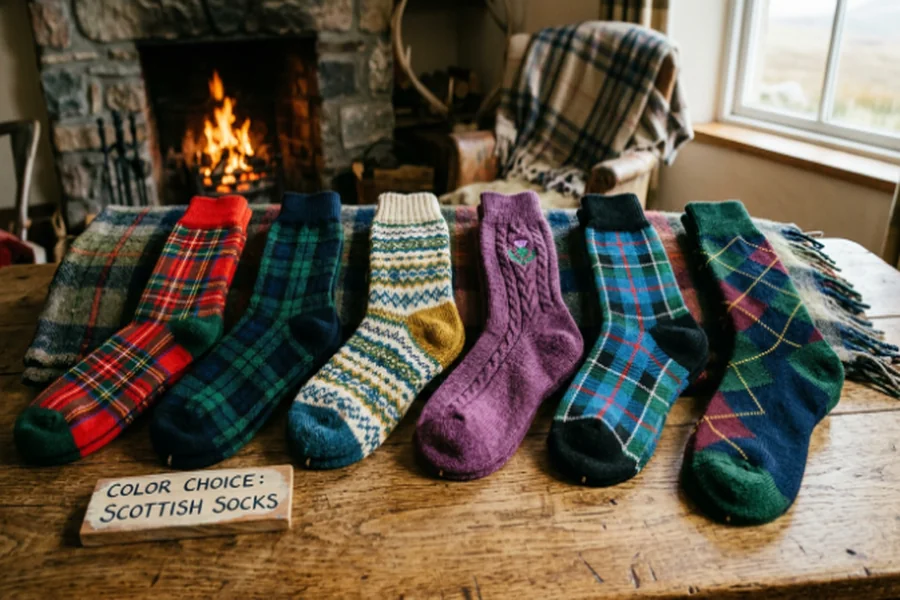
Cream / off-white kilt socks:
- The universal default for most events
- Works with virtually every tartan and outfit style
- Photographs cleanly in any lighting
- Appropriate for weddings, Burns Night, semi-formal events
- The recommended first purchase for any kilt wearer
Charcoal grey kilt socks:
- The smarter alternative for evening or formal events
- Pairs particularly well with darker tartans (Black Watch, Hunting Stewart)
- Less common but more sophisticated when chosen
- Works well in modern formal contexts
- Good second pair purchase
Pure white kilt socks:
- Reserved for military, pipe band, or specific uniform wear
- Inappropriate for most civilian formal events
- Can read as costume in non-uniform contexts
- Skip unless your specific event requires them
Black kilt socks:
- Less common but acceptable for very dark formal outfits
- Can create heavy-leg appearance with dark tartans
- Most experienced wearers avoid pure black for general use
- Use only with specific outfit reasoning
Dark navy kilt socks:
- Increasingly popular alternative to charcoal
- Works well with most tartans
- Reads slightly more modern than cream
- Solid choice for second or third pair
The general rule: cream covers most occasions; charcoal handles formal and dark-tartan contexts; everything else is specialty.
Wool Weight by Climate
Beyond color, wool weight matters for comfort.
Lightweight wool blend (about 250g per pair):
- Best for warm-weather summer events
- Less insulating but more comfortable in heat
- Suitable for outdoor festivals in summer
- Stretches and shapes faster
Medium-weight pure wool (about 350g per pair):
- The standard for most year-round wear
- Versatile across temperature ranges
- The recommended weight for first kilt sock purchase
- Holds shape over years of wear
Heavyweight wool (about 450g+ per pair):
- Best for cold-weather outdoor events
- Genuinely warm and insulating
- More dramatic visual presence
- Can be too warm for indoor formal events
For most buyers, medium-weight pure wool is the right starting point. Add a lightweight pair if you attend many summer events.
Garter Flashes: The Other Sock Detail
Kilt socks pair with garter flashes — the small ribbons that peek out from the folded sock cuff. These serve two functions:
Functional: They hold up the elastic garter that keeps the socks from sliding down during wear.
Aesthetic: They add a small accent of color that breaks up the otherwise plain cream or charcoal sock area.
Standard flash colors:
- Red: The universal default. Works with almost any tartan or outfit.
- Color matched to tartan: Pulled from a strong color in your kilt’s tartan.
- Color matched to tie: Coordinates with the upper-outfit accessories.
Both legs should have matching flashes positioned identically.
Common Kilt Sock Mistakes (And Fixes)
The errors that consistently appear at first events:
Mistake 1: Wearing regular tall socks instead of proper kilt socks.
Fix: Buy actual kilt socks.
Mistake 2: Synthetic socks marketed as “kilt socks.”
Fix: Verify wool content in product specifications.
Mistake 3: Pulling the socks too high.
Fix: Position the unfolded sock to two fingers below the kneecap, then fold the cuff down.
Mistake 4: Mismatched cuff folds.
Fix: Fold both cuffs to exactly the same depth.
Mistake 5: No garter flashes.
Fix: Buy flashes.
Mistake 6: Treating socks like regular laundry.
Fix: Hand-wash in cold water with mild wool detergent. Lay flat to dry.
How Kilt Socks Complete the Full Outfit
A complete kilt outfit for most formal occasions includes the kilt socks as one of the foundational lower-body elements.
Building a Kilt Sock Collection Over Time
Starter collection (year 1):
- 1 pair cream wool kilt socks
- 1 set red garter flashes
Expanded collection (year 2-3):
- Add 1 pair charcoal grey kilt socks
A complete collection rarely exceeds $200 total and lasts many years with proper care.
Frequently Asked Questions
Can I wear regular tall socks with a kilt?
Technically possible but immediately reads as wrong.
Are kilt socks the same as kilt hose?
Yes. The terms are used interchangeably.
Do I need different kilt socks for different tartans?
Generally no. Cream and charcoal handle almost all tartans.
How long do quality kilt socks last?
With proper care: 5-10 years of regular wear.
Should kilt socks be tight or loose?
Snug but not tight.
Quality kilt socks are the silent foundation of every successful kilt outfit. Skip them and the entire look reads incomplete. Get the basics right — cream wool, mid-weight, properly folded cuffs, matched red flashes — and you have the visual anchor that makes the rest of your kilt outfit work. It’s the smallest piece you’ll spend money on, and it’s the one that experienced wearers care most about. Get this right first, and everything above the knees follows.