There has never been more freely available cooking instruction than there is right now. On any given afternoon, a curious home cook can watch a Michelin-starred chef break down the technique for a perfect beurre blanc, learn knife skills from a culinary school instructor in Tokyo, follow a French pastry chef through the lamination of a croissant dough, and then watch a street food vendor in Oaxaca demonstrate a mole negro that took forty years to develop.
\All of it is free. All of it is on demand. And all of it has contributed to a question that gets asked with increasing frequency in culinary circles: if the world’s best cooking knowledge is available on a phone screen, does formal culinary training still matter?
It is a fair question, and it deserves a serious answer rather than a defensive one.
Table of Contents
ToggleWhat digital learning does extraordinarily well.
The democratization of culinary knowledge through video content is genuinely remarkable. Techniques that were once passed only through direct mentorship in professional kitchens — brunoise cuts, tempering chocolate, emulsification, the Maillard reaction in different fat compositions — are now explainable by anyone with a camera and the ability to teach. Passionate self-taught cooks have developed real technical proficiency through sustained engagement with high-quality online content, and some have translated that proficiency into careers, food businesses, and even restaurant concepts.
For home cooks, hobbyists, and people building supplemental skills, digital learning is often exactly the right tool. It is flexible, affordable, and almost infinitely customizable. If you want to learn only sourdough, you can learn only sourdough, and you can learn from three different experts whose approaches differ in interesting ways.
Where the limits appear.
The problem with self-directed digital learning in culinary arts is not the quality of the content — it is the architecture of the learning itself. Watching a technique performed perfectly on screen is categorically different from executing that technique under pressure, receiving immediate corrective feedback from an experienced chef, and then repeating the execution until it becomes muscle memory rather than conscious effort.
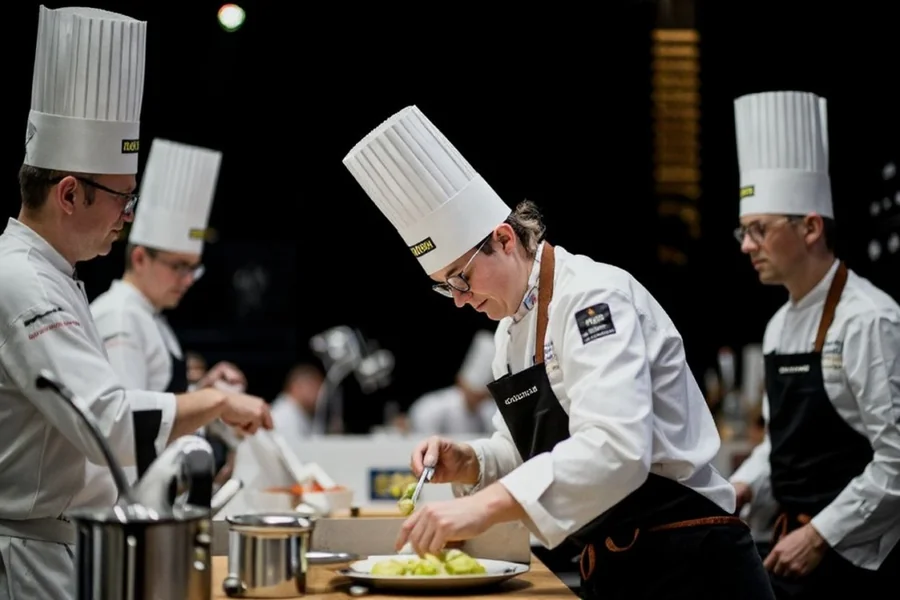
Professional kitchens operate at speeds and under pressures that video instruction cannot simulate. The timing of a multi-course service, the coordination of station work across a full brigade, the physical and mental management of heat, equipment, noise, and constant decision-making — these are not skills that can be developed by watching. They are skills that require doing, repeatedly and in conditions that approximate the real environment.
There is also the question of foundational curriculum structure. A self-directed learner on YouTube follows their curiosity, which tends to lead toward the dramatic and the interesting rather than the systematic and the essential. The result is often a cook who can execute visually impressive techniques but struggles with the more invisible fundamentals — proper stock-making, sauce mother construction, mise en place discipline, flavor balancing — that professional cooking rests on. The gaps are not obvious until the pressure is real.
What structured training provides that algorithms cannot.
Formal culinary education offers something that no content platform has yet been able to replicate: a designed curriculum that builds skill in a logical sequence, ensuring that foundational techniques are mastered before more complex ones are attempted. A student who enters a structured culinary program doesn’t get to skip the fundamentals because they’re less interesting than plating or molecular technique. They cook through them, repeatedly, until the basics become reflexive.
The presence of experienced chef instructors provides the kind of corrective guidance that is impossible to receive through a screen. A chef watching a student’s knife hold can identify a subtle inefficiency that the student has no reference point to notice themselves. That correction, given in the moment during actual practice, consolidates in a way that watching even perfect video demonstration cannot match.
Externship and real-world kitchen placement — standard components of quality programs — provide the professional environment exposure that bridges formal training and industry readiness. The transition from student kitchen to professional kitchen is significant; programs that include supervised, real-industry work experience shorten that transition meaningfully.
A Culinary Arts Diploma program structures this entire developmental arc — from foundational technique through international cuisine, with exposure to baking, pastry, and healthy cuisine applications — into a coherent learning journey that produces graduates who are kitchen-ready in ways that self-taught cooks, however talented, typically are not.
The credential question.
Beyond the practical skill development, formal culinary training carries credential value that matters in certain career trajectories. Executive chef positions at established restaurants and hotel properties, food and beverage management roles, and culinary leadership careers in healthcare, hospitality, and education often use formal training as a baseline qualification. It signals commitment to the craft, documented competency, and the ability to function within professional culinary standards — all of which are difficult to demonstrate through a self-taught pathway, however genuine the skill.
The honest answer.
Formal culinary training and digital learning are not competitors — they serve different purposes at different stages of a culinary journey. For someone building casual proficiency or exploring a passion, video content is extraordinary. For someone committed to a professional culinary career, the structured, hands-on, feedback-intensive environment of formal training provides a developmental foundation that free content simply cannot replicate.
The question isn’t whether YouTube has changed how people learn about food — it has, and irreversibly. The question is whether it has changed what professional kitchens require of the people who work in them. And on that question, the answer is clearly no.