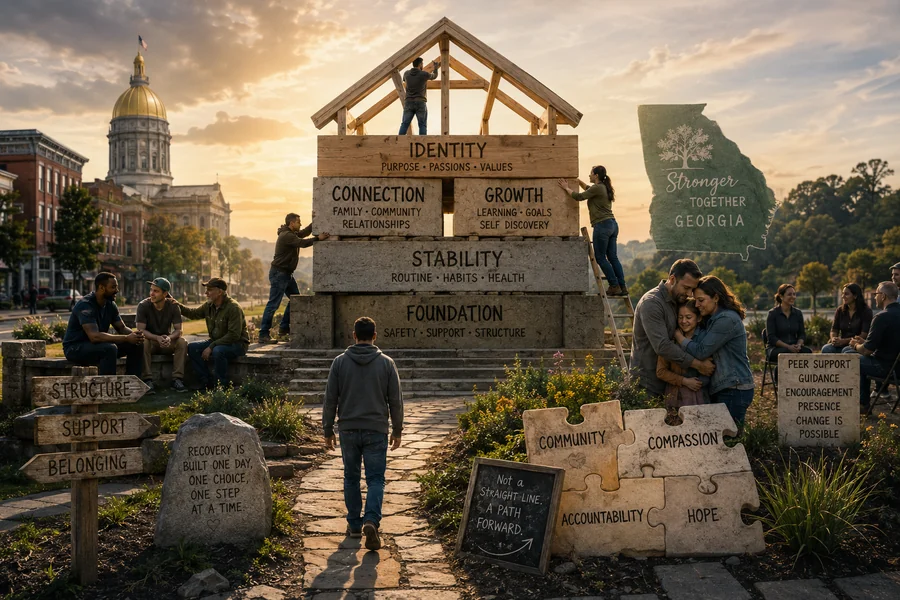
Recovery is often spoken about as a turning point—a single decision, a moment of clarity, a before-and-after story. But in reality, it rarely works that way. For most people, recovery is built slowly, layer by layer, like an invisible architecture forming beneath everyday life. It is not just about stopping a harmful pattern; it is about constructing something stable enough to replace it.
In Georgia communities, this process is shaped by a mix of cultural values, family ties, local support systems, and the growing awareness of how structured care can influence long-term change. What emerges is not just recovery in isolation, but recovery embedded in environment, relationships, and routine.
Table of Contents
ToggleRecovery as a Structure, Not a Moment
One of the most misunderstood aspects of healing from substance use challenges is the expectation of instant transformation. In truth, lasting change behaves more like a structure under construction than a switch being flipped.
Structure matters because it replaces unpredictability. When someone begins rebuilding their life, the absence of chaos is not enough—they need patterns that hold. These patterns can be simple: waking up at a consistent time, eating regularly, reconnecting with responsibilities, or establishing a sense of daily direction. Over time, these become the scaffolding that supports emotional stability.
In many parts of Georgia, where community identity is often closely tied to family and local connection, this structure is reinforced by interpersonal relationships. Family gatherings, shared responsibilities, and community involvement can all serve as anchors, helping individuals regain a sense of rhythm that addiction often disrupts.
The Role of Support Systems in Early Recovery
Support is not just emotional encouragement. It is also practical, consistent presence. It is the difference between trying to rebuild alone and having people who help hold pieces of life together while stability is still forming.
Support systems can take many forms: family members who remain engaged, peers who understand similar struggles, mentors who offer guidance, or structured environments that reduce isolation. In Georgia communities, where interpersonal ties are often deeply rooted, support networks can become especially influential in shaping recovery outcomes.
However, support is not always automatically present or healthy. In some cases, relationships may need to be rebuilt or redefined. This is where boundaries become important. Support that helps recovery is steady, not controlling; encouraging, not enabling; present, but not overwhelming.
The healthiest support systems are those that allow space for accountability while still offering compassion. They do not try to “fix” the person but instead create an environment where change feels possible and sustainable.
Structure and Support Working Together
Structure without support can feel rigid and isolating. Support without structure can feel comforting but unstable. Recovery requires both working in balance.
Structure provides predictability. Support provides resilience. Together, they create a framework where setbacks do not become collapse points, but rather adjustments within a larger system.
This is why long-term recovery is often described less as a straight line and more as a layered process. Each layer—routine, emotional regulation, social reconnection, and personal identity—builds on the one before it. When one layer weakens, the others help stabilize the whole.
In this sense, recovery is not about perfection. It is about reinforcement.
The Environment of Georgia Communities
Place matters more than it is often given credit for. Georgia’s communities vary widely—from dense urban areas to rural towns—but many share a strong sense of identity tied to family, tradition, and local belonging. These elements can both support and challenge recovery.
On one hand, strong community ties can provide accountability and connection. People are less likely to feel invisible. There is often someone who notices when things are improving—or struggling. This visibility can encourage healthier choices and reinforce progress.
On the other hand, close-knit environments can sometimes carry stigma or misunderstanding around substance use challenges. This is where education and open conversation become important. As awareness grows, so does the ability for communities to respond with empathy rather than judgment.
Across many parts of the state, there has been a gradual shift toward understanding recovery as a health process rather than a moral failure. This shift is subtle but significant, and it influences how people engage with resources, relationships, and long-term healing pathways.
In this evolving landscape, access to Georgia Addiction Treatment Centers becomes part of a broader conversation about care, continuity, and community integration—less as isolated interventions and more as components within a larger recovery ecosystem.
Rebuilding Identity Beyond Survival
One of the most overlooked stages of recovery is what happens after immediate stability is achieved. Once the crisis phase passes, a deeper question often emerges: Who am I now?
Addiction often compresses identity into survival mode. Days revolve around managing cravings, consequences, or emotional distress. When that cycle begins to loosen, there is space—but also uncertainty.
Rebuilding identity involves rediscovering interests, values, and aspirations that may have been buried or paused. This can be a slow process. It might start with small things: revisiting hobbies, reconnecting with creative outlets, or setting goals that extend beyond immediate survival.
In Georgia communities, this rebuilding is often supported through social reintegration—returning to work, engaging in local activities, or rebuilding family roles. These experiences help reinforce a sense of belonging that is essential for long-term stability.
Identity reconstruction is not about becoming someone entirely new. It is about reconnecting with parts of oneself that were overshadowed by struggle.
The Importance of Time in Healing
Recovery cannot be rushed without consequences. While early progress can feel motivating, sustainable change requires time for new habits to settle and strengthen.
Time allows the brain and body to adjust. It allows emotional responses to stabilize. It allows trust—both internal and external—to rebuild. Most importantly, it allows setbacks to be reframed as part of the process rather than signs of failure.
In structured recovery environments, time is not wasted—it is utilized. Each phase serves a purpose, whether it is stabilization, skill-building, or reintegration.
This pacing is often what makes the difference between temporary change and lasting transformation.
Community as an Ongoing Framework
Recovery does not end when formal support decreases. Instead, it transitions into a different phase where community becomes the ongoing framework for maintenance and growth.
This can include continued participation in peer groups, ongoing family engagement, or simply maintaining healthy routines that were established earlier in the process. The key idea is continuity—staying connected to elements that reinforce stability.
In Georgia, where local identity and interpersonal relationships often remain strong over time, this continuity can be a powerful protective factor. People are not just supported during crisis moments; they are supported across seasons of life.
Final Reflection
Recovery is often imagined as a dramatic turning point, but in practice, it is something far more subtle and enduring. It is the gradual construction of structure where there was once instability, the rebuilding of trust where there was once distance, and the slow return of identity where there was once survival.
In Georgia communities, this process is shaped by a unique combination of structure, support, and belonging. When these elements align, they create more than recovery—they create a foundation for a renewed life.
And while the journey is rarely linear, it is deeply human. Built quietly, maintained steadily, and strengthened over time, recovery becomes less about escaping the past and more about constructing something stable enough to move forward into the future.